
Skip to content
NRCan_Earthquakes_Canada_Image

Canada’s National Earthquake Early Warning System

From Design to Deployment: How Nanometrics Delivered Canada's Critical EEW Infrastructure
CLIENT

nrcan-logo-cutout-png

PROJECT
Establish Canada’s First Nation-Wide Earthquake Early Warning (EEW) Network
Instruments
TitanSMA Accelerograph
Apollo Server Software
Applications
Earthquake Early Warning
Earth Sciences Research

SUMMARY

Over the past five years, Natural Resources Canada (NRCan) has developed Canada’s first nation-wide Earthquake Early Warning (EEW) system to rapidly detect earthquakes and deliver alerts to the public. Much like the Canadian National Seismograph Network (CNSN), the EEW network stations also provide information and data to researchers looking to better understand Canada's seismic hazard, geology, and tectonic history. The system comprises two networks: one in the west, and one in the east. The western half, in the province of British Columbia, became fully operational in August 2024. The eastern half, in the provinces of Quebec and Ontario, followed in November 2025.

To establish its EEW capability, NRCan chose Nanometrics for the station instrumentation, design, and installation of 140 stations. The seismic instrumentation forming the backbone of the EEW array is the TitanSMA — an all-in-one, high-performance accelerograph — as well as additional accelerographs from another supplier. Over 190 units were installed in the network.
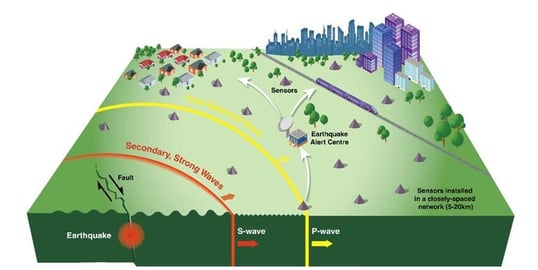
NRCan Earthquakes Canada Earthquake Early Warning System

Image: NRCan Earthquakes Canada, "An illustration of how an EEW system works."

Data is transmitted reliably and with low latency into multiple EEW data centers, where it is received by the Nanometrics’ Apollo Server acquisition platform. Canada’s Earthquake Early Warning System notifies Canadians of seismic activity and automates the shutdown of key infrastructure. The system sends alerts to cell phones (Alert Ready), radios, and televisions, providing tens-of-seconds’ notice before the arrival of strong-motion waves, which are responsible for the kind of powerful shaking that can cause significant damage.
background

Naturally-occurring seismic activity in Canada primarily affects populations in the provinces of British Columbia, Ontario and Quebec, with potential risk is highest in British Columbia. Running along the province’s coast is the Queen Charlotte Fault and part of the Cascadia Subduction Zone. Both of these fault lines can trigger earthquakes of magnitude 8.0 - 9.0 or more. In 1949, the province experienced the largest earthquake in Canadian history — a magnitude 8.1 event along the Queen Charlotte Fault.

Experts have estimated that high-magnitude earthquakes in population-dense locations throughout these regions could cause tens of billions of dollars in damage and pose a significant human-casualty risk.

In 2021, NRCan publicly announced the project to develop a new EEW system in collaboration with Nanometrics and other vendors. The system would be designed to alert for potentially harmful earthquakes along the west coast of British Columbia, as well as the Ottawa River Valley and the Saint Lawrence Seaway in Ontario and Quebec, with the aim of reducing potential damage and risks to human life.

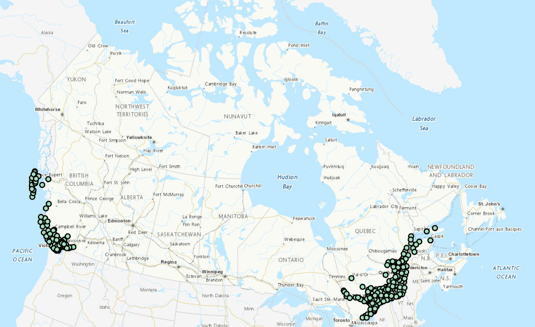
QW Station Book Index, Map of Canadas Earthquake Early Warning Network

Image: CN, QW Station Book Index, Canadian National Earthquake Early Warning Network (QW).
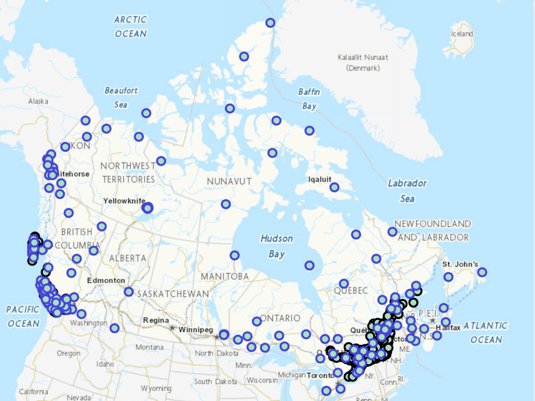
 

CN,QW Station Book Index - Map of Canadas Earthquake Early Warning Network

Image: CN, QW Station Book Index, Canadian National Earthquake Early Warning Network (QW) combined with the Canadian National Seismic Network (CN).


Technical Requirements and Challenges

EEW systems are designed to rapidly detect earthquakes and provide warning to population centers before the damaging seismic waves arrive. As such, EEW systems require that seismic data is delivered to network data centers reliably and as quickly as possible. The appropriate definition and selection of sensors, data loggers, power systems, and communication systems is essential. Some of the key challenges for the NRCan EEW array included:

  • Selecting high quality Class A accelerometers with sufficient dynamic range to detect fainter P-waves for providing early warning, but capable of withstanding the strong motion of S-waves without clipping
  • Implementation of a reliable, low-latency, and secure data acquisition system, with careful consideration for digitization / packetization, telemetry selection, and network robustness via layers of redundancy
  • Ensuring that the system can handle the sudden spike in data volume associated with large earthquakes, due to reduced effectiveness of seismic data compression algorithms during heavy shaking
  • Specialized system installation requirements across Canada, in diverse urban and rural environments, with an accelerated deployment schedule

SOLUTION

To address these challenges, NRCan worked collaboratively with Nanometrics, as well as other selected vendors, on a robust solution configuration that included:
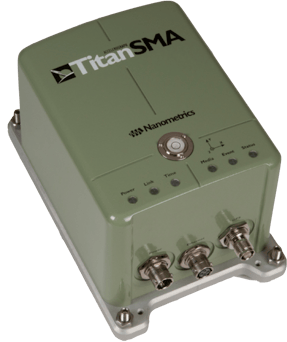
TitanSMA

TitanSMA: Best-In-Class Accelerograph for Mission-Critical Networks

The TitanSMA is a Class A strong-motion accelerograph (all-in-one accelerometer & digitizer) designed for high-precision engineering applications. It provides high dynamic range over a wide frequency band required for dependable EEW stations, with market-leading low self-noise in a single, compact chassis, which is optimal for free-field deployment. 

TitanSMA is highly configurable, with the flexibility to tune data digitization and packetization to optimize latency and bandwidth performance for project specific requirements. It supports streaming using Nanometrics Protocol (NP), a full-featured real-time transmission protocol with robust automatic outage recovery, prioritization of real-time data, multicast streaming support and other capabilities to ensure reliable and prompt acquisition of seismic data (see Nanometrics Protocol section below).

Apollo Server Software: Key Data Acquisition and Management System

Nanometrics Apollo Server is Enterprise Data Center software used to acquire data streamed using the NP. Apollo Server manages end-to-end acquisition, including the automatic recovery of data missed due to communications outages, to ensure maximum data completeness at the data center. Data is efficiently forwarded to downstream processing toolchains using the industry standard SeedLink protocol.

Apollo Server also provides comprehensive network monitoring capabilities. These are vital for mission-critical, real-time public safety systems such as EEW networks, which must detect the first sign of a problem to allow immediate action and minimize downtime. Detailed real-time acquisition performance metrics are captured on a per packet basis. This data can be inspected using built-in dashboards and is also available programmatically via robust APIs for real-time tracking and alerting using external network monitoring systems.

Apollo Server supports acquisition of multicast streams and gracefully handles receipt of duplicate data. This allows implementation of sophisticated streaming topologies and data center architectures, which provide robustness through redundancy while supporting efficient synchronization across redundant toolchains.

Apollo Server has centralized fleet management tools, including bulk firmware distribution and a batch configuration utility that allows the efficient, non-disruptive execution of a network bandwidth stress test. The test involves temporarily configuring network data loggers to stream uncompressed data for a period of time to simulate the effect of a large earthquake. This capability allows operators to verify telemetry network performance under stress conditions without disrupting the normal operation of the network.

 

Nanometrics Protocol (NP): Critical Element of an Earthquake Early Warning System

NRCan selected the NP protocol, acquired by Apollo Server, for real-time streaming of seismic data from TitanSMAs to their data centers. NP is a lightweight, full-featured protocol designed to provide robust, low latency acquisition performance in all scenarios. As a critical piece of the solution for the NRCan EEW system, it offers:

  • Real-time Prioritization: NP prioritizes the immediate transmission of real-time data. Data missed due to communications outages is recovered automatically, but as a background task and only when sufficient extra bandwidth is available, ensuring minimum disruption to critical-path early warning processing.
  • Variable Length Packets: NP allows tuning of the packet size to support optimization between low data latency, as required for EEW systems, and bandwidth efficiency. 
  • Bandwidth Throttling: NP allows limiting the maximum bandwidth used for a stream to prevent packets from being dropped at telemetry system bottlenecks, helping to ensure maximum acquisition reliability.

  • Multicast Streaming: Networking protocol that allows real-time packets to be routed to multiple destinations, enabling the use of redundant acquisition servers without increasing bandwidth cost.
  • Multidisciplinary Data Support: In addition to seismic channels, NP supports transmission of geodetic data from GNSS receivers, which is increasingly critical for EEW processing, allowing unified acquisition systems and streamlined infrastructure for multidisciplinary stations.


Seismic Network Installation and Engineering Services

In cooperation with local community stakeholders and contractors, the Nanometrics' team of field application engineers executed turnkey installations of over 140 stations across Canada, in both remote and urban areas. Nanometrics brought experience from thousands of seismic station installations, in challenging environments across the globe, and successfully deployed these stations within the two-year project timeline.

undefined-May-12-2026-03-39-02-6007-PM
Iain Avis, Field Engineering Specialist, at NRCan EEW Quebec Deployment 2024

IMPACT: A SAFER CANADA

Working efficiently through the requirements of this publicly funded project, including robust verification processes, the NRCan EEW and Nanometrics project teams completed the delivery on time. The EEW network is one element of a broad national strategy towards natural disaster risk mitigation and this historic achievement will help reduce the impacts of large, damaging earthquakes.

MORE ABOUT EARTHQUAKE EARLY WARNING

Publications, Posters and Press Releases


Posters

A National Earthquake Early Warning System for Canada (David McCormack, Henry Seywerd & Stephen Crane)  [2020]

The test suite and the baseline performance for Canada’s National Earthquake Early Warning System (Stephen Crane, Paige Saravanamuttoo, Henry Seywerd)
Canadian Hazards Information Service, Natural Resources Canada - presented at the Seismological Society of America meeting [April 2026]

Operating EEW in Eastern Canada Part II: Seismological Parameters (Stephen Crane, Claire Perry, Michal Kolaj, John Adams, Henry Seyward) Canadian Hazards Information Service, Natural Resources Canada - presented at the Seismological Society of America meeting, abstract P. 1277 [April 2026]

Outreach and engagement to ensure the success of Canada’s Earthquake Early Warning System (Alison L. Bird, Henry Seywerd, Chris Boucher, Stephen Crane, Charles Blais) Canadian Hazards Information Service, Natural Resources Canada - presented at the Seismological Society of America meeting [April 2026]

TRUAA Network: Upgrading the Israel Seismic Network Towards Earthquake Early Warning in Israel (Ittai Kurzon, Ran N. Nof, Michael Laporte, Hallel Lutzky, Andrey Polozov, DovZakosky, Haim Shulman, Ariel Goldenberg, Ben Tatham, Michael Perlin)
American Geophysical Union [2019]

Seismic Data Compressions and Telemetry Bandwidth Considerations for EEW (Michael Laporte, Michael Perlin, Marian Jusko, Ted Sommerville, Bruce Townsend)
American Geophysical Union [2023]


Publications

The “TRUAA” Seismic Network: Upgrading the Israel Seismic Network—Toward National Earthquake Early Warning System (Ittai Kurzon, Ran N. Nof, Michael Laporte, Hallel Lutzky, Andrey Polozov, Dov Zakosky, Haim Shulman, Ariel Goldenberg, Ben Tatham, Yariv Hamiel) Seismological Research Letters [August 2020]

National Earthquake Early Warning for Canada (Stephen Crane, Henry Seywerd, John Adams, Alison Bird, Michal Kolaj, Claire Perry) Canadian Conference - Pacific Conference on Earthquake Engineering 2023 Vancouver, British Columbia [June 25]


Earthquakes Canada Sites, National Research Council of Canada

Earthquake Early Warning - Frequently Asked Questions

Significant Events Site - Shake Maps


Press Releases

"Canada Activates Earthquake Early Warning System in Quebec and Ontario." Natural Resources Canada, Nov. 2025 

 "Governments of Canada and British Columbia Highlight Earthquake Early Warning System Launched in Western Canada to Strengthen Ability to Respond to Natural Disasters." Government of Canada, Aug. 2024 

"Nanometrics Wins Government of Canada Contract to Provide the Infrastructure for Canada's Early Earthquake Warning System." PR Newswire, May 2021