

.png?width=300&name=image%20(8).png)
From Design to Deployment: How Nanometrics Delivered Canada’s Critical EEW Infrastructure

BACKGROUND
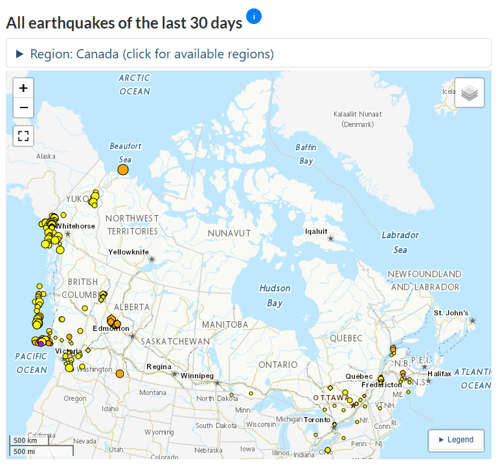
Naturally-occurring seismic activity in Canada primarily affects populations in the provinces of British Columbia, Ontario and Quebec, however, potential risk is highest in British Columbia. Running along the province’s coast is the Queen Charlotte Fault and part of the Cascadia Subduction Zone. These fault lines can trigger earthquakes of magnitude 8.0 - 9.0 or more. In 1949, the province experienced the largest earthquake in Canadian history — a magnitude 8.1 event along the Queen Charlotte Fault.
Experts have estimated that high-magnitude earthquakes in population-dense locations throughout these regions could cause tens of billions of dollars in damage and pose a significant human-casualty risk.
In 2021, NRCan publicly announced the project to develop a new EEW system in collaboration with Nanometrics and other vendors. The system would be designed to alert for potentially harmful earthquakes along the west coast of British Columbia, the Ottawa River Valley, and the Saint Lawrence Seaway in Ontario and Quebec, with the aim of reducing potential damage and risks to human life.
Photo right: Courtesy of https://www.earthquakescanada.ca/index-en.php
THE PROJECT
Technical Requirements and Challenges
EEW systems are designed to detect earthquakes as quickly as possible to be able to provide warning to population centers before the damaging seismic waves arrive. As such, EEW systems require that seismic data is delivered to network data centers reliably and as quickly as possible. The appropriate definition and choice of sensors, data loggers, power systems, and communication systems, is essential. Some of the key challenges for the NRCan EEW array included:
- Selecting high quality Class A accelerometers with sufficient dynamic range to detect fainter P-waves for providing early warning, but capable of withstanding the strong motion of S-waves without clipping
- Implementation of a reliable, low-latency, and secure data acquisition system, with careful consideration for digitization / packetization, telemetry selection, and network robustness via layers of redundancy
- Ensuring that the increased data volume during large seismic events can be handled. Seismic data is generally encoded using “Steim” compression, which is known as a first-difference algorithm:
- During large events, the differences between samples grow, requiring more bits to record, and, as such, increased data volume
- Specialized system installation requirements across large rural and remote regions of Canada, over a relatively short deployment period
 Solution
To address these challenges, Nanometrics worked collaboratively with NRCan, as well as other selected vendors, on a robust solution configuration that included:
TitanSMA: Best-In-Class Accelerometer and Digitizer for Critical Networks
The TitanSMA is a Class A strong-motion accelerograph designed for high-precision engineering applications. It provides high dynamic range over a wide frequency band required for dependable EEW stations, with market-leading low self-noise in a single, compact chassis, which is optimal for free-field deployment.
(Photo: NRCan EEW Quebec Deployment 2024)
TitanSMA is highly configurable, with the flexibility to tune data digitization and packetization to optimize latency and bandwidth performance for project specific requirements. It supports streaming using NP, a full-featured real-time transmission protocol with robust automatic outage recovery, prioritization of real-time data, multicast streaming support and other capabilities to ensure reliable and prompt acquisition of seismic data (see Nanometrics Protocol).
Apollo Server Software: Key Data Acquisition and Management System
Nanometrics Apollo Server is Enterprise Data Center software used to acquire data streamed using the Nanometrics Protocol (NP). Apollo Server manages end-to-end acquisition, including the automatic recovery of data missed due to communications outages, to ensure maximum data completeness at the data center. Data is efficiently forwarded to downstream processing toolchains using the industry standard SeedLink protocol.
Apollo Server also provides comprehensive network monitoring capabilities. These are vital for mission-critical real-time public safety systems such as EEW networks, which must detect the first sign of a fault to allow immediate action and minimal downtime. Detailed real-time acquisition performance metrics are captured on a per packet basis. This data can be inspected using built-in dashboards and is also available programmatically via robust APIs for real-time tracking and alerting using external network monitoring systems.
Apollo Server supports acquisition of multicast streams and gracefully handles receipt of duplicate data. This allows implementation of sophisticated streaming topologies and data center architectures, which provide robustness through redundancy while supporting efficient synchronization across redundant toolchains.
Notably, the Apollo Server also allows for the non-disruptive execution of network-bandwidth stress tests, among other fleet management tools.
As discussed in the sections above, EEW systems typically feature an increase in throughput demand (The total sum of energy and data passing through the EEW system.) as a result of the substantial ground-shaking that accompanies large seismic events. This can cause a sudden, if temporary, four-fold spike in required bandwidth to keep data moving from sensor to server.
Apollo Server addresses this by offering acquisition system-testing capabilities which mimic maximum data volume case. When used, stations are instructed to temporarily transmit data uncompressed (4 Bytes / sample) for a period of time, to simulate the effect of such an earthquake. Given the data center processing, toolchains continue to receive valid seismic data, and the operation of the network is not disrupted.
Moreover, multiple data loggers can be configured remotely via Apollo without compromising the functionality of the system during the process, ultimately allowing for a myriad of unobtrusive system alterations, such as remote firmware updates — something that is key when it comes to post-deployment access in Canada’s most rural and remote terrain.
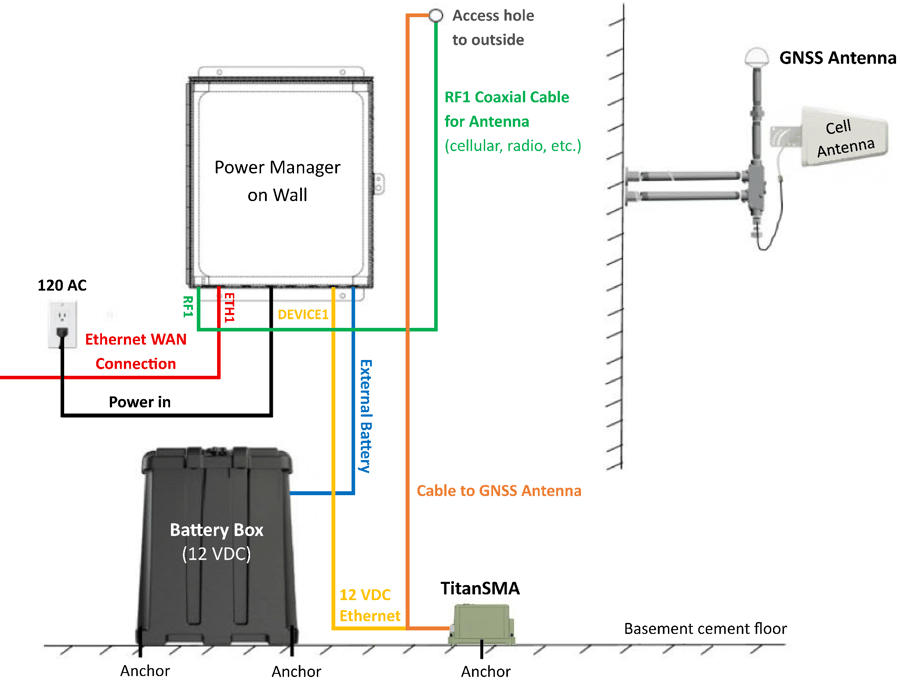
NOTE: The figure above displays connectivity for Ethernet WAN and cellular communications in order to reflect comprehensive station configurations, however, only one method is respectively employed per station.
STATION AND COMMUNICATIONS DESIGN
 Each station includes seismic instrumentation, a power-management system, batteries, and a modem for data streaming. In addition, server redundancy is integrated through the establishment of multiple data centers as a fail-safe for suboptimal conditions.
Seismic Network Installation and Engineering Services
To meet the project deliverables, over 140 stations, many in remote locations across Canada, were installed over a short two-year period. The Nanometrics team of field application engineers — alongside representatives from respective local communities and electrical contractors, as applicable — brought experience of installing thousands of seismic stations to support smooth, successful deployments and the project timeline.
(Photo right: Iain Avis at NRCan EEQ Quebec Deployment 2024)