

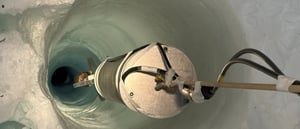
The Deepest Seismometer System Deployed in the Quietest Environment

Two stations containing:
-
Trillium 360 GSN Posthole Seismometer (Polar Certified)
-
Centaur Data Logger
- Redefine New Low Noise Model
- Enhance global safety/preparedness for earthquakes and tsunamis
- Study ice movement, global seismicity, deep earth structure
BACKGROUND
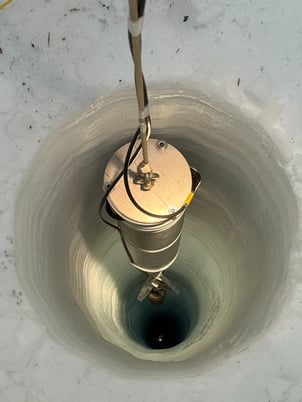
In January 2026, Nanometrics seismic instruments were "frozen in" more than 8,000 feet (2,500 meters) beneath the South Pole icecap.
Suspended deep within the ice, the two Nanometrics Trillium 360 GSN Postholes and Centaur data loggers are now operating in one of the coldest and quietest environments on Earth. The system allows scientists to detect the most subtle seismic signals with unprecedented clarity, helping measure global earthquakes, support tsunami alerts, and monitor nuclear testing.
The historic deployment is a result of the partnership between the U.S. Geological Survey Golden Colorado / Albuquerque Seismological Laboratory and the IceCube Neutrino Observatory, University of Wisconsin-Madison and marks one the deepest deployments of a seismic system. Nanometrics worked in collaboration with these two high-impact scientific institutions to provide seismology instrumentation and systems expertise that enabled the project.
Photo right: Deep Ice Seismometer System being lowered into QSPA station, Antarctica. Courtesy of Skyler Grulke, IceCube Neutrino Observatory, NSF.
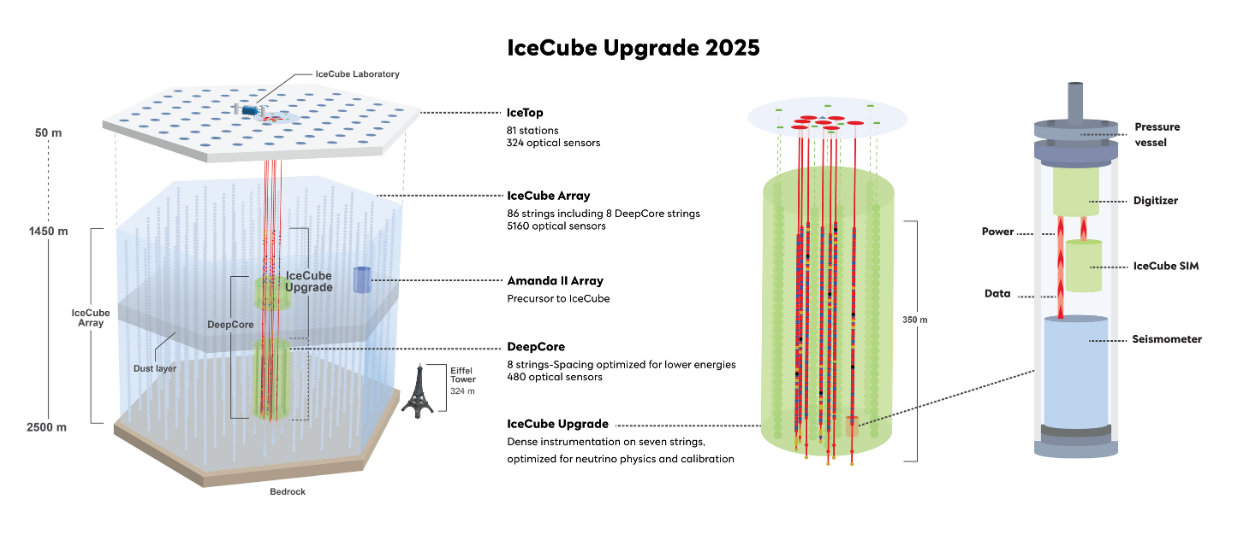
Diagram of IceCube Deep Ice Seismometer Project, Antarctica (Image courtesy of IceCube Neutrino Observatory)
THE PROJECT
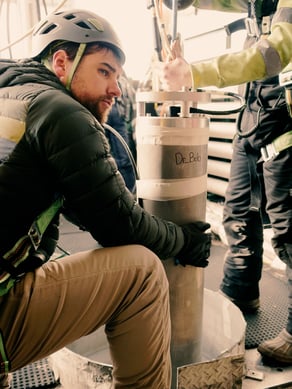
Redefining the New Low Noise Model
In development for over three years, this project grew out of an opportunity to upgrade the aging Quiet South Pole, Antarctica (QSPA) stations. Technology has advanced significantly since these stations were installed, and it was determined that the seismology community would benefit from data from the quietest seismometers in the world.
Of the many scientific objectives this new seismic system can provide, the specific objective for Robert Anthony (photo left), Geophysicist, and the USGS Golden Colorado team, is to attempt to redefine the industry standard New Low Noise Model (NLNM) (Peterson 1993). The Trillium 360 GSN Posthole seismometer is being used as the redefining sensor. It seeks to provide baselines for higher frequencies (10 - 100 Hz) in this new NLNM as the original NLNM was limited to low frequencies (1 - 10 Hz).
“[...] the Earth rings like a bell following large earthquakes … by analyzing the frequencies at which the bell rings, you can kind of understand the composition of the deep interior of the planet,” Anthony explains. “But because the ‘bell’ is spinning, at most seismic stations these frequencies get distorted by Earth’s rotational effects. But if you’re right at the South Pole, you don’t have this rotation distortion.” (Ref: SSA Article, 'At Work: Robert Anthony' , Ayesha Davis)
Deploying in the Antarctic: December 2025 to January 2026
The South Pole is the ideal location for this type of study as it is one of the quietest places on Earth to obtain seismic data; however, it poses a challenging deployment environment. For over 60 years, the U.S. Geological Survey has operated a seismic station in the Antarctic as part of the Global Seismographic Network (GSN)*. Seismic observations from this location fill a large geographic gap on the planet, are used extensively to accurately locate earthquakes across the world, and aid in monitoring for explosions. The current station, known as Quiet South Pole, Antarctica (QSPA), has been collecting data since 2002.
The system components, including the electronics/communications package, Centaur data logger, and Trillium 360 GSN PH seismometer, are housed in a custom pressure vessel. Before being shipped to Antarctica for deployment, the seismic system was first assembled and tested by teams from Albuquerque Seismological Laboratories and Wisconsin IceCube Particle Astrophysics Center, Physical Sciences Laboratory, University of Wisconsin–Madison.
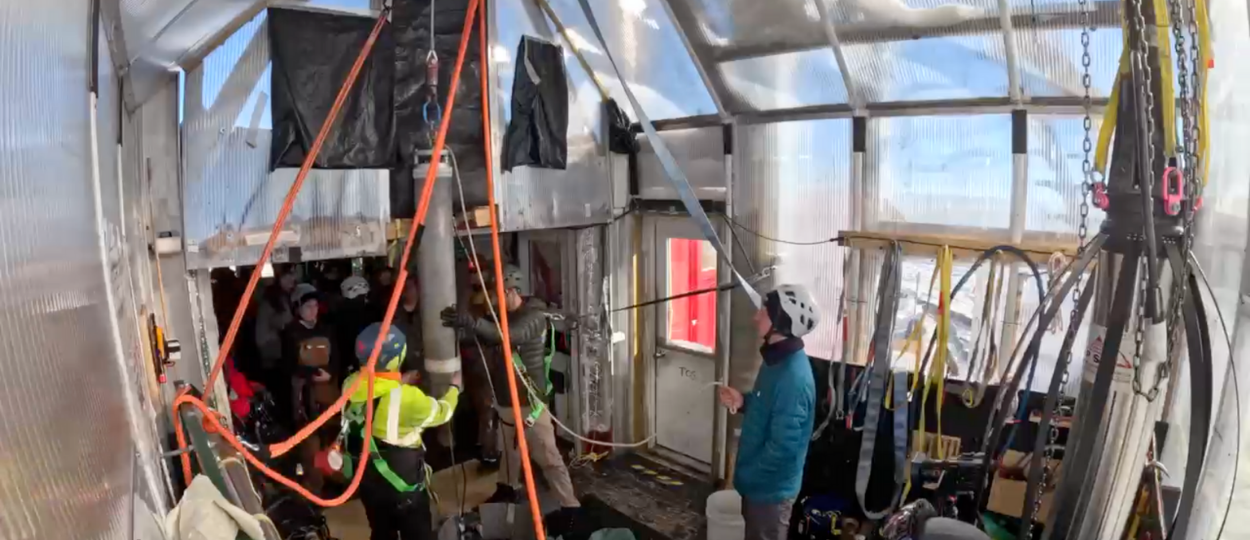
(Rob Anthony and Team Deploying Deep Ice Seismometer, Photo courtesy of USGS)
Station Deployment: QSPA Network
Of many critical steps in the project, deployment was the most critical and determined if the project would be successful.
In December 2025 the instrumentation arrived in Antarctica and the team had successfully installed the permanent “deep ice” seismometer system by January 2026. The 8,000 foot (2,500 meter) hole was drilled using IceCube’s innovative drilling technology and methods. The hole was only open for 72 hours to enable the emplacement of the pressure vessel, containing the Trillium 360 GSN PH seismometer, Centaur data logger, and electronic and communications components. After the pressure vessel was lowered into the hole, the climate naturally did the work; there was no need to add snow or material, and the hole simply froze closed. The instrumentation will remain in this location permanently. More sites with the Trillium 360 GSN PH broadband seismometers will be installed once the initial deployment is completed as this would improve the QPSA network further enhancing performance and advancing the scientific objectives. Watch the video and read USGS's January 2026 article for more information and photos.
Why did USGS & IceCube choose Nanometrics instrumentation?
This is a “Mission Critical Operation” so the project is using the most reliable instrumentation to ensure a successful outcome.
Nanometrics contributed seismic engineering and instrumentation expertise to the project including conceptualizing the mounting design for the seismometer within the pressure vessel. Custom cabling was also provided to connect the the polar rated data logger and seismometer. The strategy was to use mature firmware and hardware to minimize operational risk and make the least modifications to the proven technologies within the sensor and datalogger package.
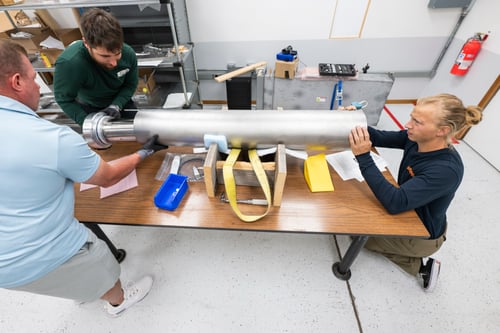
The Trillium 360 GSN Posthole Seismometer:
- The quietest broadband seismometer available, meaning it is a highly sensitive seismometer that will ‘hear’ the faintest signals that the earth produces, from gravitational pull to oscillations of seismic signals from the entire earth from earthquakes.
- Polar Certified: can withstand extremely cold temperatures up to -50 degrees celcius.
- Has magnetic shielding to prevent geomagnetic storms (which are intense at the Earth’s poles) from interfering with the seismic signal
- Detects not only high frequency but low frequency signals (hence the term broadband as the seismometer can detect the entire range of frequencies generated by seismicity around the world).
(Jason Patton, Rob Anthony, and Skyler Grulke slide a part into the pressure vessel tube while assembling a seismometer at the Physical Sciences Laboratory in Stoughton, Wisconsin on Aug. 7, 2025. Photo courtesy of Taylor Wolfram / UW–Madison)
The Centaur Data Logger - Best-in-Class High-Fidelity Data Acquisition System:
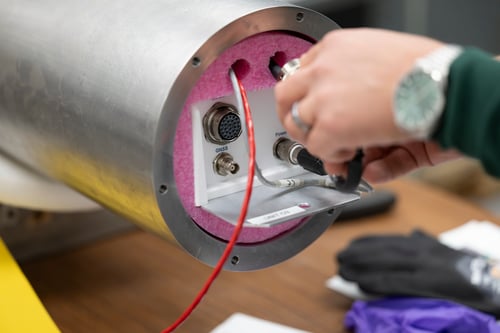
- A mature proven product known for reliability and repeatable performance meeting specifications that support mission critical networked operations, like earthquake early warning, global seismic network and nuclear treaty monitoring.
- Polar Certified: meets polar requirements
- Smart sensor integration provides seamless system level communications and operations
(Rob Anthony puts in the Seismometer Interface Module while assembling a seismometer at the Physical Sciences Laboratory in Stoughton, Wisconsin on Aug. 7, 2025. Photo courtesy of Taylor Wolfram / UW–Madison)
*Global Seismographic Network (GSN) is a network of seismic sites around the world. It is a permanent, state-of-the-art digital network of seismic sensors distributed globally to monitor Earth's interior, provide real-time earthquake and tsunami data, and support research, education, and public safety. The GSN is a joint program of the National Science Foundation (NSF) and the U.S. Geological Survey (USGS).